"Colourtext always take a fresh approach to discovering hidden patterns in data. Whether you want to conduct segmentation or mine your CRM for deep insights, they will help you see your customers , and what they are seeing , in new ways."


Advanced marketing mix modelling that reveals how offline media channels really work – and makes the case in the rooms where budgets are decided.
Somewhere this week, a brand team is in a budget meeting, looking at a model output and deciding what gets spent and what gets cut. It might be called Marketing Mix Modelling. It might be called econometrics. It might be called "the attribution dashboard the CFO trusts". But it amounts to the same thing: if a media channel doesn’t show up properly in that system, it doesn’t have a pricing problem or a pitch problem. It has a measurement problem. And measurement problems turn into revenue problems remarkably quickly.
We’re living through a generational shift in who sets the rules of measurement. A new generation of media professionals has been trained on digital platforms where everything behaves like pay-per-click: clicks, conversions, immediate and measurable response. That’s not a criticism, it’s simply the new industry landscape. But it means that when these professionals evaluate legacy channels like television, radio or outdoor, they’re looking for the return path, the click trail, the conversion. And offline platforms can’t provide that. Not in the same way.
The consequence is significant. Offline media no longer controls the narrative about what good advertising measurement looks like. It’s being judged by rules it didn’t write, in a game it didn’t design. That’s a strategic disadvantage, and it’s one the industry needs to address.
The Offline Attribution Trap
When sophisticated econometric modelling isn’t available, something else fills the measurement vacuum. And that something else is usually attribution – which has its place, but comes with a built-in bias. Attribution was designed for clicks. It works best when a system can watch a person do a thing, immediately, and tag it. This makes it structurally poor at seeing how offline channels actually work.
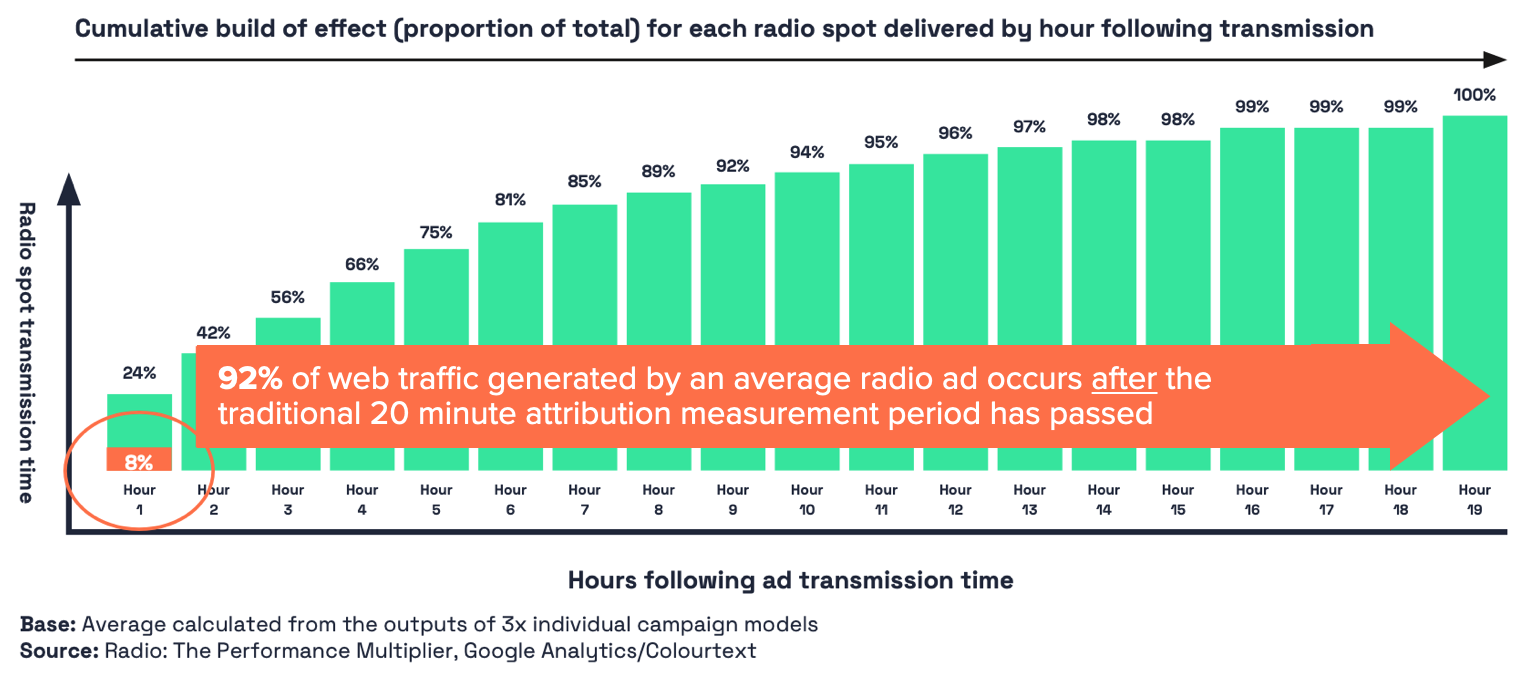
Colourtext has direct experience of this problem. In a study for Radiocentre in the UK, we found that standard short-term attribution windows were capturing only about 8% of radio’s actual ad response. The remaining 92% was happening outside the measurement window and getting credited to whatever channel was sitting there ready to collect it – usually paid search. Radio looked weak and disposable. It looked like the kind of budget line item you’d cut to fund more search ads. But the problem wasn’t radio’s performance. The problem was the measurement.
This is the offline attribution trap. It’s not that broadcast channels stop working. It’s that attribution measurement stops seeing them. And when a channel becomes invisible to the measurement system, it becomes “ineffective” in budget meetings remarkably quickly. In a world where outcomes-based evaluation increasingly drives budget allocation, a channel that cannot be measured properly becomes the channel that gets cut.
What Colourtext Does About It
Colourtext has set out to address this problem with advanced econometric modelling built specifically for the needs of media owners. Our approach differs from the way most brand-side or agency-side econometrics is conducted, in three important ways:
1. We work with the data that's already available
In theory, every brand team and their agency wants an econometric model. In practice, projects often stall – not because of technical problems or budget, but because someone’s waiting on a spreadsheet that’s been “coming next week” for the fourth month running. The uncomfortable truth is that offline media is often under-represented in econometric models simply because the data isn’t in the room. It’s late, it’s incomplete or it’s in a format that can’t be joined to anything else.
Meanwhile, digital has the advantage of being born model-ready. It arrives with tags, timestamps and a click trail. So when the modelling starts, digital is sat at the table with its name badge on, and offline is still outside looking for the door.

Colourtext has learned to work with whatever data is available. And it turns out, quite a lot is at hand if you know where to look. The standard industry measurement currencies are great - they give us the most accurate laydown of campaign impacts for a given channel. Web traffic estimates from platforms like SimilarWeb and Semrush hold up well against actual analytics data for modelling purposes. YouGov’s BrandIndex tracks brand awareness and consideration for hundreds of brands on a weekly basis. Sales transaction data is available through panel providers. And competitive media spend data from Ad Intel captures the patterns of activity across channels – and for modelling purposes, it’s the pattern that matters, not the precise rate card.
This means Colourtext can build econometric models at speed and at scale, without waiting for permission from busy clients or agencies. We’ve built our approach around data sources that are already in the bag: hundreds of brands, years of history, ready to go.
2. We treat econometric modelling as a search problem
Colourtext uses an ensemble modelling approach that runs hundreds, often thousands, of logically possible model variants across channels, brands, outcomes and assumptions. A typical analysis for a single brand advertiser generates around three hundred automated model variants. A multi-brand category or full market analysis can produce thousands. These are pushed through an automated quality control process that filters out statistically weak models, leaving only the robust results worthy of deeper analysis.
You simply cannot do this by hand. And you certainly can’t do it economically if you’re paying a consultancy by the hour. The advantage of a search-based approach is that instead of insights based on a single model, it yields a broader body of evidence that contextualises the insights revealed by any individual model. Effects that show up consistently across many model variants are far more trustworthy than a finding that appears in one specification and vanishes in another.
The point isn’t to replace human judgement. Even when modelling is done properly, most of the time the raw output is coefficients and p-values – a forest of charts that only a modeller can love. You still need a human in the loop who understands what a good model looks like, when to trust a result and when to be sceptical.
3. We focus on commercial outputs, not academic ones

No media planner or sales director wants an econometric model dropped into their lap. What they want is a story they can tell in a budget meeting or post-campaign review. So the outputs Colourtext focuses on are commercial rather than academic.
We show campaign timelines as layered decomposition charts: here’s what baseline traffic looked like, here’s what media added, here’s how much of that was television versus radio versus paid search. That’s a picture anyone can use. We produce uplift figures for brand outcomes: this campaign generated a given percentage increase in web traffic or ad awareness over baseline, and here’s how each channel contributed. Those are numbers you can put in a pitch deck. And we run optimisation scenarios – if you shift budget from one channel to another, here’s the projected change in outcomes for the same total spend. No extra money required. Just smarter allocation.
Key Concepts: How Offline Media Really Works
Much of Colourtext’s econometric modelling work reveals consistent patterns in how offline media channels like television, radio and outdoor create value for brands. Three concepts are central to understanding what the models tell us.
Adstock - the Slowly Fading Light Bulb

When a brand runs a pay-per-click campaign, the effect is essentially instantaneous. Someone searches, they click, they convert – or they don’t. Turn off the spend and the effect stops. PPC behaves like a light switch: on, off, immediate.
Offline media doesn’t work like that. The advertising effect of television, radio and outdoor is more like a slowly fading light bulb. You switch it off and the room doesn’t go dark immediately. The glow lingers and fades over weeks and months, rather than disappearing in hours or days.
In econometric modelling, this fade rate is captured by a concept called adstock. Adstock models how the effect of an advertisement doesn’t just happen the moment it airs, but builds up and decays over time. It reflects the idea that exposure to advertising today can influence consumer behaviour days or weeks later, through memory, awareness and delayed decision-making.
The rate of decay is measured by a parameter called alpha. Alpha is a number between zero and one. The closer to one, the slower the fade. An alpha of zero means advertising effect vanishes instantly. An alpha of 0.95 means 95% of the accumulated effect carries forward from one week to the next. That doesn’t sound dramatic until you do the maths: at an alpha of 0.95, it takes fourteen weeks for half of a brand’s accumulated advertising memory to drain away. That’s a quarter of a year.
The Persistence Dividend
When a media channel displays high adstock persistence – a high alpha value – it behaves less like a tactical expense and more like a durable investment. The accumulated effect of advertising compounds and carries forward, building a reservoir of brand memory that continues to influence consumer behaviour long after the campaign has ended.
This is what we call the persistence dividend. It’s the contribution to business outcomes that unfolds over a longer horizon than standard measurement systems typically capture. And it matters commercially because if a channel’s effects have a fourteen-week half-life and you’re evaluating it over a four-week window, you’re only seeing a fraction of what it actually delivers.
The reservoir metaphor is useful here. Advertising spend tops up the reservoir of brand memory. Consumer outcomes – web visits, app downloads, search behaviour – draw from it. The alpha value determines whether that reservoir drains quickly or slowly. Choosing to pause a high-persistence channel doesn’t feel like a dramatic decision in week one, because the reservoir is still full. But it’s draining. And by the time the performance consequences show up, the connection to the decision to pause has often been forgotten.
The Interaction Effect
In a standard marketing mix model, channels are treated as independent: each contributes its own estimated effect, and the model adds them together. That's a perfectly reasonable starting assumption, but it quietly implies something quite radical – that the effectiveness of any given channel is completely independent of what other channels in the mix are doing. In practice, that assumption is often wrong.
Imagine a consumer who sees a brand advertisement on television. They don't act immediately. But the ad registers. It sits in memory. Later that week, when they need the product, they hear a radio ad closer to the moment of purchase. It uses the same audio cues as the TV ad – the actor's voice, the music bed, the jingle – thereby invoking all of the persuasive imagery of the TV exposure. This compounding effect is a classic example of the 'Virtual TV' effect, which increases the likelihood of purchase. The two channels did not operate independently – one contributed towards the conditions that helped the other to succeed. This is the interaction effect – the idea that one channel can change how effectively other channels in the mix do their job.
Why Media Owners Need Their Own Econometrics

Most econometric modelling in the advertising industry is commissioned by brands and agencies. The models are designed to answer a brand’s question: how should I allocate my budget? That’s a legitimate and valuable use of the technique. But it leaves media owners in a reactive position, waiting to see how their channel performs in someone else’s model, built to someone else’s specification, using someone else’s assumptions.
Colourtext’s view is that media owners – particularly those operating television, radio and outdoor platforms – need their own econometric modelling capability. Not only to produce ad marketing collateral, but also to genuinely understand how their channel creates value, where attribution systems misrepresent them, and what evidence they can bring into the rooms where budgets are decided.
Media owners don’t have to accept the idea that, because first-party conversion data isn’t available, their channel should be invisible to either attribution measurement or econometric modelling. Invisibility is not a neutral outcome. In a budget meeting, an invisible channel becomes perceived as ineffective remarkably quickly. And the worst part is, it won’t feel like a dramatic moment. It will feel like a series of sensible decisions: a small cut here because the model didn’t show much, a budget shift there because search is more accountable, a planning rule that quietly makes offline channels the thing you invest in when there’s money left over.
Colourtext’s position is simple. If offline media doesn’t engage with econometric modelling on its own terms, it will continue to be judged by attribution methodologies that were designed for activation, not branding. And that is a strategic disadvantage that doesn’t help anyone – least of all brand advertisers, who need balanced media strategies to help drive brand growth and win market share.
Work with us
Colourtext builds advanced econometric models for media owners, industry bodies and agencies. We help offline platforms demonstrate their advertising value with robust, evidence-based analysis that can stand up in a budget meeting.
If you’re a media owner or agency planner who wants to understand how your channel really performs in the marketing mix – and have the evidence to prove it – we’d like to hear from you.
Contact: [email protected]