"Colourtext always take a fresh approach to discovering hidden patterns in data. Whether you want to conduct segmentation or mine your CRM for deep insights, they will help you see your customers , and what they are seeing , in new ways."


Cut TV once, pay twice. A new econometric modelling analysis from TAM Ireland & Colourtext on the commercial effectiveness of television advertising.
You might not be interested in attribution measurement, but attribution measurement is interested in you.
Somewhere in an office this week, a brand team is having a budget meeting, looking at some kind of post-campaign review, and deciding what gets spent and what gets cut. It might be called Marketing Mix Modelling. It might be called econometrics. It might be called the attribution dashboard the CFO trusts. It amounts to the same thing. If your channel doesn't show up properly in that system, you don't have a pricing problem or a pitch problem. You have a measurement problem. And measurement problems turn into revenue problems remarkably quickly.
That observation is the starting point for 'The TV Persistence Dividend: Cut TV Once, Pay Twice', a new econometric modelling project Colourtext has been working on with TAM Ireland. It leads to an awkward observation about television specifically. Television is now fighting two measurement battles, not one.
The first is the familiar audience measurement debate. Trusted, independently governed audience currencies like TAM Ireland, BARB, RAJAR and Route give the market a common basis for trading reach, frequency and impacts. That debate still matters enormously, and television has a stronger tradition here than almost any other medium.
The second debate is different, and it has been getting more important by the year. It is about brand outcomes, attribution, modelling and budget allocation. When a CFO asks what the media spend delivered, nobody answers only in TVRs. They want to know what happened to web visits, searches, app usage, sales revenue or some other commercial outcome.
That second battle is not where television's traditional strengths sit. It is the terrain on which budget battles are increasingly settled. The project moves television into it.
Twelve brands, two years
The credibility of 'The TV Persistence Dividend: Cut TV Once, Pay Twice' comes from the partnership behind it. TAM Ireland provides audited television audience impacts for the Republic of Ireland. That is the kind of trusted ad exposure data proper modelling needs. Colourtext's role has been to use those impacts inside an econometric framework that tests how TV activity relates to commercial brand outcomes over time.
We analysed twelve Irish consumer brands across four sectors: three supermarket brands, three retail brands, three online brands and three health insurance brands. A reasonably broad cross-section of Irish advertising, which lets us see how consistent the findings are across categories, consumer relationships and business models.

Television impacts came from TAM Ireland. Web traffic, app usage and search volumes came from Similarweb. Channel advertising spend came from Nielsen Ad Intel. Each source has known limitations against any one brand's internal numbers. What matters for modelling is that the data captures the pattern of activity over time, and these sources do that reliably enough to support broadly applicable findings.
We treated econometric modelling as a search problem. For each brand, we ran hundreds of model variants, systematically, across media channels and brand outcomes. Then we looked for patterns that repeated. The effects that showed up consistently. The effects that disappeared when assumptions changed. The effects that survived diagnostic checks.
The aim was deliberately not to expose any individual brand's performance. As a trade body, TAM Ireland's interest is in broadly applicable findings about how television is working in the Irish market. So we looked for repeated patterns of effect across brands, outcomes and categories, rather than over-relying on individual case studies.
Three findings stand out: the Google Tax, the TV Persistence Dividend, and Cut TV Once, Pay Twice.
The Google Tax
The first finding is an effect already known in the industry. It is called the Google Tax. The logic is straightforward.
Television does the hard part. It builds familiarity. It puts the brand into people's heads and nudges them closer to action. Then, later on, when those people finally get round to searching online, they type the brand name into Google, click a paid link, and the search platform sends a bill to the advertiser. The brand ends up paying twice. First for the TV advertising that created the interest. Then again for the paid click that captures it at the doorway. Television earned the visit. Paid search stood at the door and charged an entrance fee.
A careful caveat first. PPC is a highly effective channel, and it is genuinely good at converting intent once intent exists. The issue is not whether PPC works. The issue is what the attribution report does with the credit.
The Google Tax pattern repeats across four cases in three of the brands in the dataset. The clearest came from a Total Web Visits model for one of the insurance brands. Across the two-year period, television generated well over a million additional web visits and accounted for the majority of all media-driven uplift in the model. Paid search appears to have intercepted in the order of 10–12% of those visits.
A second model on the same brand looked at organic search referrals. When a paid listing sits above a free organic result, some people click the paid one instead. The model suggests around 4% of the organic referrals television had generated were diverted in this way. That model also had the strongest fit in the project, which gives the interpretation useful weight.
The pattern repeated in other categories. In an app downloads model in one of the supermarket brands, paid search appeared to intercept in the order of 3% of the downloads television had stimulated. In a branded keyword search model in one of the retail brands, the share was again closer to 11–12%.
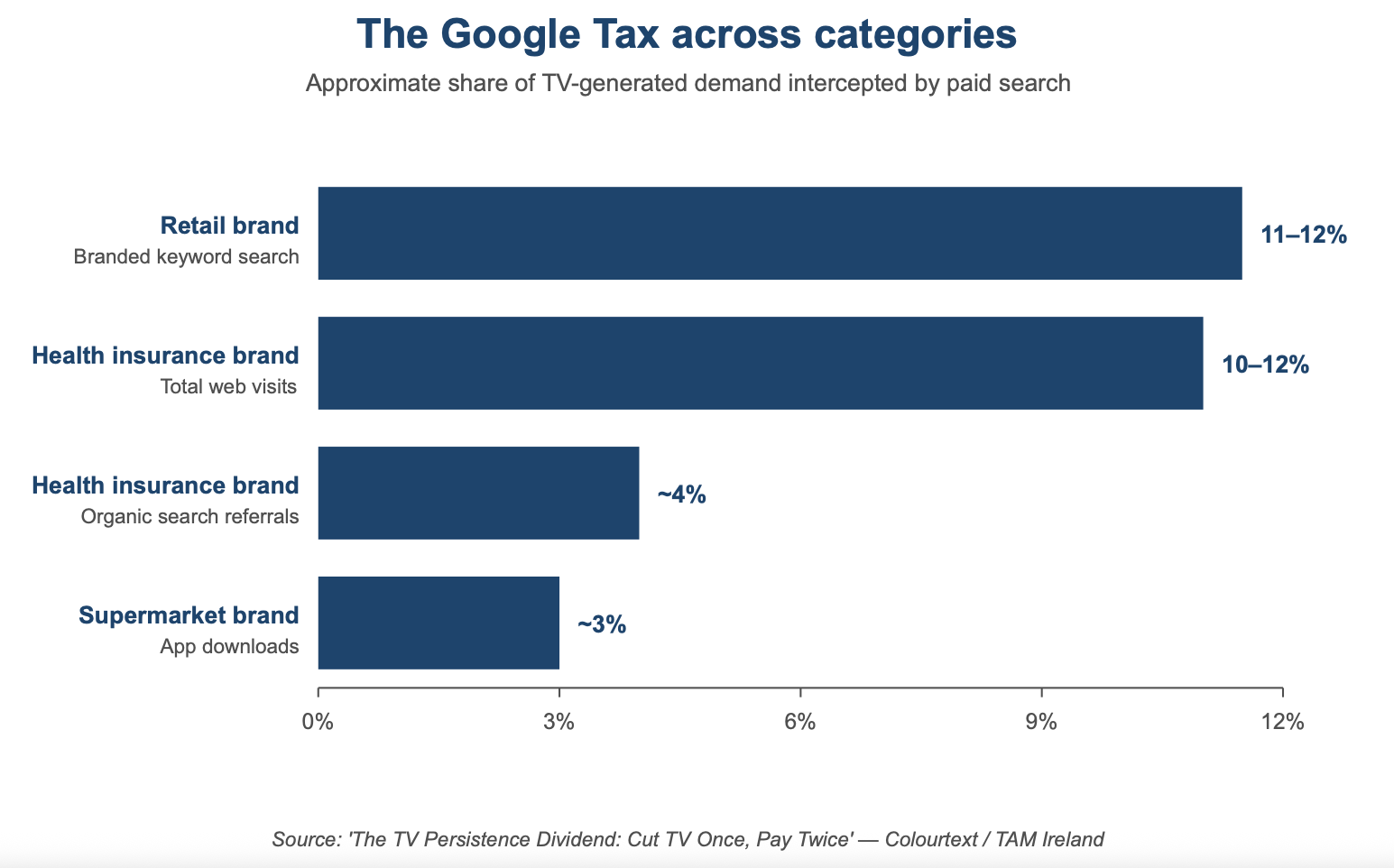
Different sectors. Different consumer behaviours. The same underlying issue. Television generates demand. Paid search captures some of it. Attribution then mistakes the easy-to-measure final step for the whole journey. The figures vary across categories. The pattern doesn't.
The TV Persistence Dividend
The Google Tax shows one way television's value can leak into paid search. The second finding is more important still for budget planning. To see it, we need to understand a defining characteristic of how television actually works.
Television's influence does not vanish when the campaign stops. It lingers, accumulates, and keeps shaping consumer behaviour long after the spot has aired. The most useful way to think about this is as a reservoir of brand memory. TV spend tops it up. Brand outcomes draw from it. The reservoir holds value over weeks, not hours.
A small metaphor helps make the contrast with paid search clear. When a brand runs a paid search campaign, the effect is essentially instantaneous. Someone searches, they click a link, and they convert, or they don't. Turn off the spend, and the paid search effect stops. Compared with television, paid search behaves much more like a light switch. On, off. Immediate. PPC is very good at that.
Television doesn't work like that. TV is more like a slowly fading light bulb. You switch it off and the room doesn't go dark immediately. The glow lingers and fades slowly over weeks and months, rather than disappearing quickly in hours or days. PPC's value is to shine while the switch is on. Television's value includes the ability to shine long after the switch is off.
The natural next question is how slowly. In econometric modelling, we measure that fade rate using something called an alpha decay parameter. Alpha is a number between zero and one. The closer it is to one, the slower the fade. An alpha of zero would mean the effect vanishes instantly, like a light switch.
Across the nine TV-focused models in the project, the median alpha for television was around 0.93. Roughly 93% of TV's accumulated brand memory effect carries forward from one week to the next. A 0.93 alpha takes about nine weeks for half of the accumulated effect of TV brand memory to drain away. Nine weeks. That isn't a short campaign window. It's longer than two months.
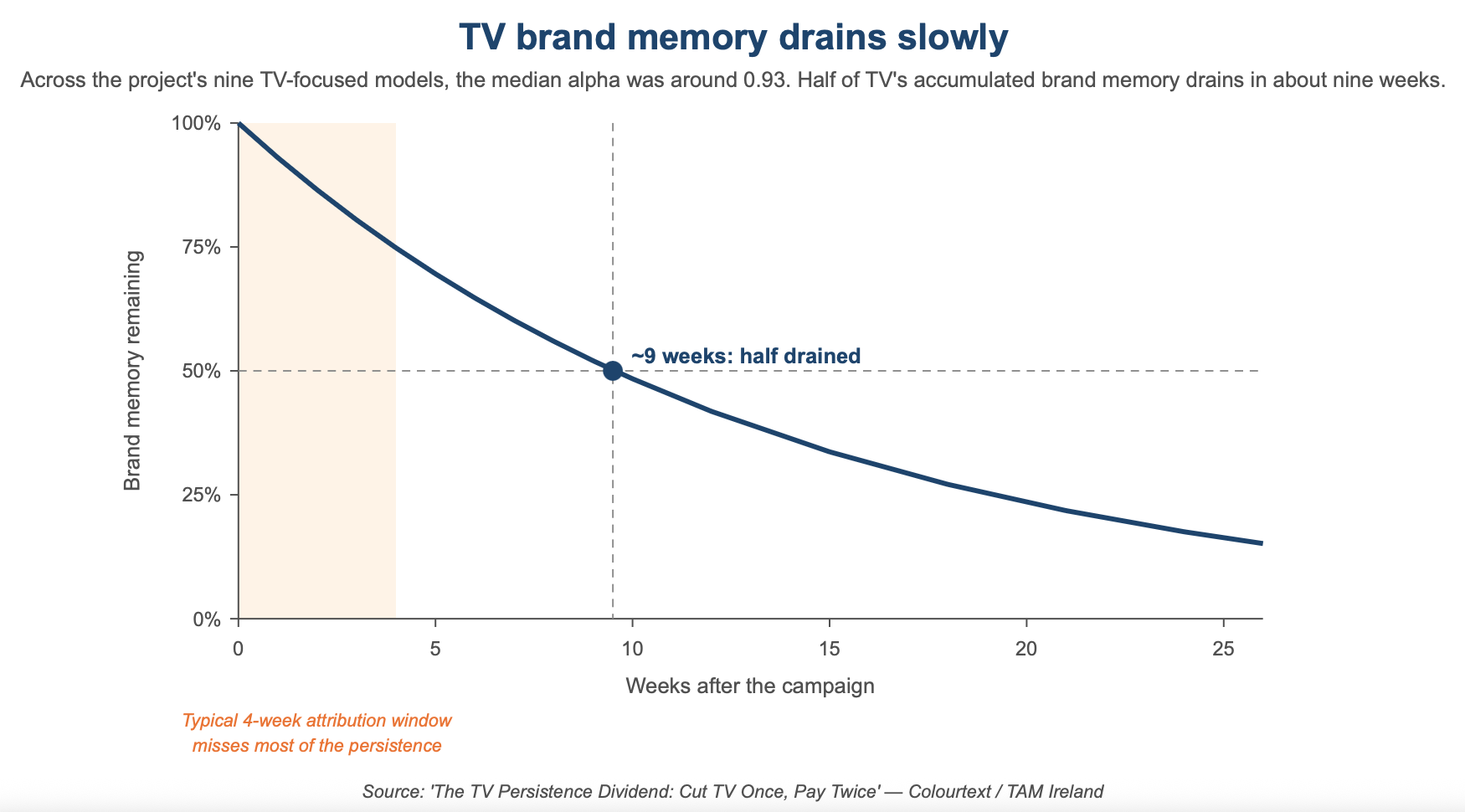
Eight of the nine models showed a long-memory effect. Individual brands sat at different points along the spectrum. In one online brand, television's alpha was very close to one, with an implied half-life closer to a year than a quarter and TV accounting for about two-thirds of all media-driven growth. In one supermarket brand, television's half-life sat around nine weeks while accounting for roughly half of media-driven growth. In a different online brand, television's half-life stretched out to around seventeen weeks.
The implication for measurement is direct. If television's effect on brand outcomes has a nine-week half-life, and you're evaluating it over a far shorter attribution window, you're only seeing a fraction of what TV actually delivers. A four-week post-campaign report that shows television looking moderately effective is almost certainly underselling television. Quarterly evaluation cycles do better. Annual evaluation does better still.
There is a planning consequence too. If TV is filling a reservoir of brand memory, choosing to pause television is not a neutral act. It feels neutral at first. Brand-tracking numbers haven't moved. The PPC dashboard still looks healthy. But the reservoir is draining. At a nine-week half-life, a TV pause of nine weeks costs roughly half the accumulated brand memory. By the time the loss shows up in paid search or other downstream channels, the connection back to the original budget cut has often been lost.
Cut TV Once, Pay Twice
The persistence dividend is one half of the budget story. The other half is what that reservoir of brand memory does to paid search.
In the Google Tax cases, we saw one way television's value can leak into paid search: TV creates demand and PPC harvests some of it at the point of search. There is a second mechanism, and it is more important for budget planning. Sometimes television does not merely send demand in PPC's direction - it makes PPC itself more productive.
The logic is straightforward. Television reaches people earlier, before they're ready to act. It builds familiarity, reduces uncertainty and makes the brand feel more recognisable when a buying moment eventually arrives. Later on, when consumers exposed to TV reach a search page, PPC is no longer addressing a cold audience. It is addressing people whose minds have already been warmed up by television. In those conditions, the paid listing carries more weight than it otherwise would. PPC is still doing useful work but it's doing it with help.
That is the part standard attribution usually misses. A last-click system sees the paid search ad at the end of the journey and gives it the credit. It does not see the television campaign that made the click more likely in the first place.
To test for that effect properly, you need a different kind of econometric model. A standard marketing mix model usually treats channels as independent. An interaction model tests something more realistic. It asks whether PPC's effectiveness changes when television activity is present.
In two clear and robust models in the project, it did. In a Total Web Visits model for one of the online brands, paid search delivered roughly half as much again at typical levels of TV ad weight. PPC was materially more productive because TV was active in the background. In an app downloads model for one of the health insurance brands, the uplift was even larger, closer to two-thirds more than PPC was producing on its own. The same model also estimates that around one in six of the app downloads generated through television's priming effect are likely being misattributed to paid search.
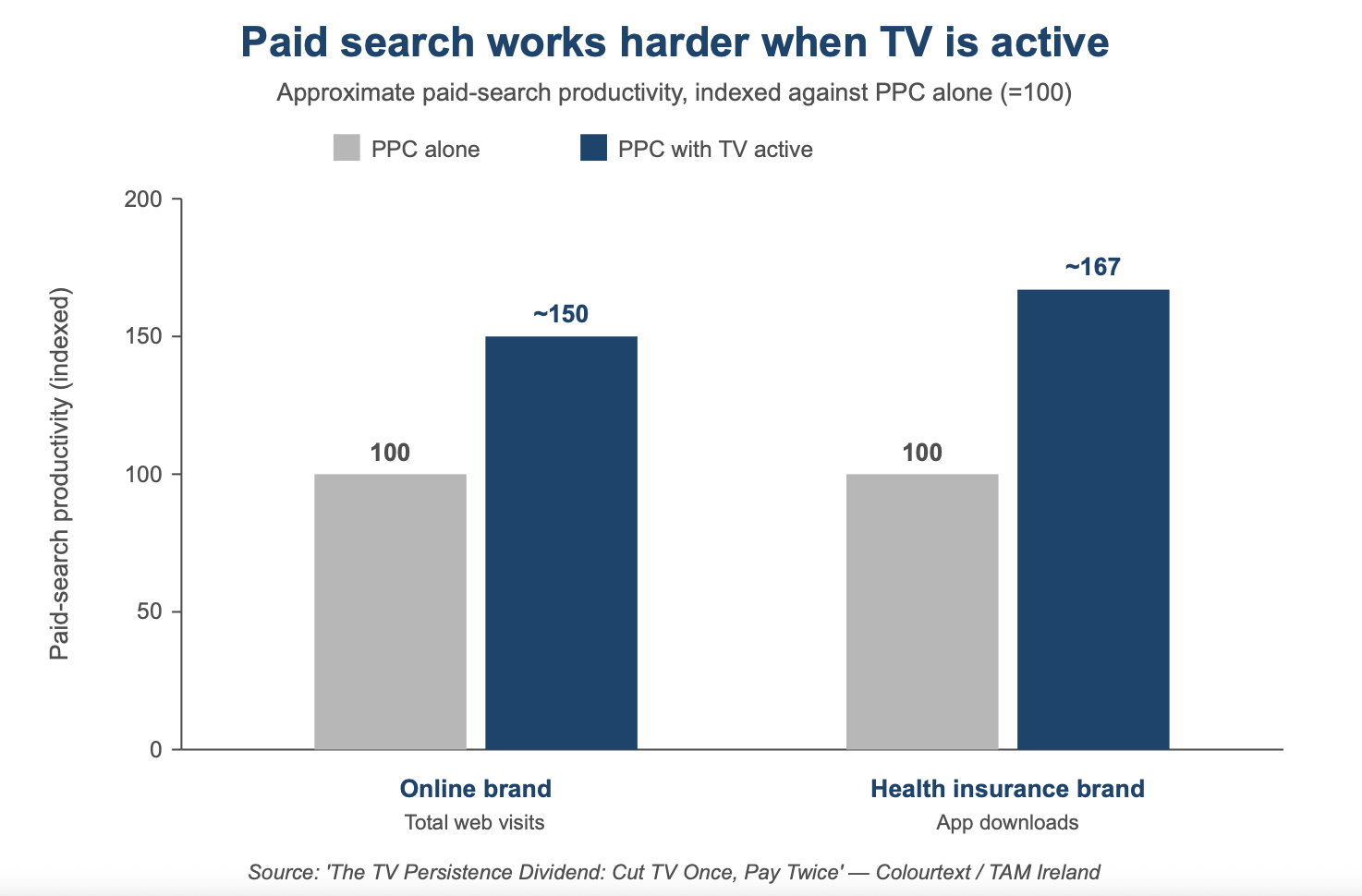
So the measurement problem is doing two things at once. It is overstating PPC's independent performance and it's hiding television's indirect commercial contribution.
That is the logic behind the phrase Cut TV Once, Pay Twice. Cut television once, and you take two hits. The first hit is obvious. You lose television's own direct contribution to web visits, app downloads or whatever outcome you are measuring. The second hit is easier to miss. You also weaken the reservoir of consumer intent that had been making paid search work harder. PPC becomes less productive, but the connection to the earlier TV budget cut is rarely visible in a standard attribution report.
The first cost is priced in. The second cost almost never is.
That second hit doesn't usually show up in week one. The brand memory reservoir drains gradually. Search efficiency softens. Cost per acquisition starts to rise. Conversion performance looks a little less impressive than it did before. The usual diagnosis is rising competition, higher keyword prices or tired creative. The possibility that paid search is underperforming because television support was reduced weeks or months earlier is not the sort of thing standard attribution is built to spot.
What this means for media budgets
Once you see the three findings together, a lot of media-planning behaviour starts to make uncomfortable sense. If PPC looks more productive than television on paper, planners and automated budget optimisers will naturally be tempted to move money out of TV and into search. But if some of PPC's apparent strength is actually being lent to it by television, that reallocation is self-defeating. You are not shifting money from a weak channel to a strong one. You are cutting support from the channel that was helping paid search perform.
The cycle compounds. TV support drops. The reservoir drains. PPC efficiency softens. The next quarter's attribution report still favours paid search, because the visible numbers all point that way. Another TV cut follows. The whole mix degrades quietly. The implication is not that paid search is ineffective. It plainly is effective. The implication is that television is often doing more commercial work than standard measurement gives it credit for. It generates direct outcomes of its own. It creates demand that paid search later harvests. In some cases it actively raises the productivity of paid search itself.
A channel that works over months should not be judged by a measurement window of just hours or days. A channel that builds demand should not be undervalued because another channel captures that demand later. A channel that can raise the productivity of paid search should not be treated as though it sits outside the performance marketing story. You might not be interested in attribution measurement, but attribution measurement is interested in you.
Get in touch
'The TV Persistence Dividend: Cut TV Once, Pay Twice' is a working partnership between Colourtext and TAM Ireland. If you'd like to talk about what this work might mean for your channel, brand or attribution measurement approach, we'd be glad to hear from you.
Email us or get in touch with our CEO Jason Brownlee directly on LinkedIn.